Northern Lights at Jökulsárlón and Diamond Beach
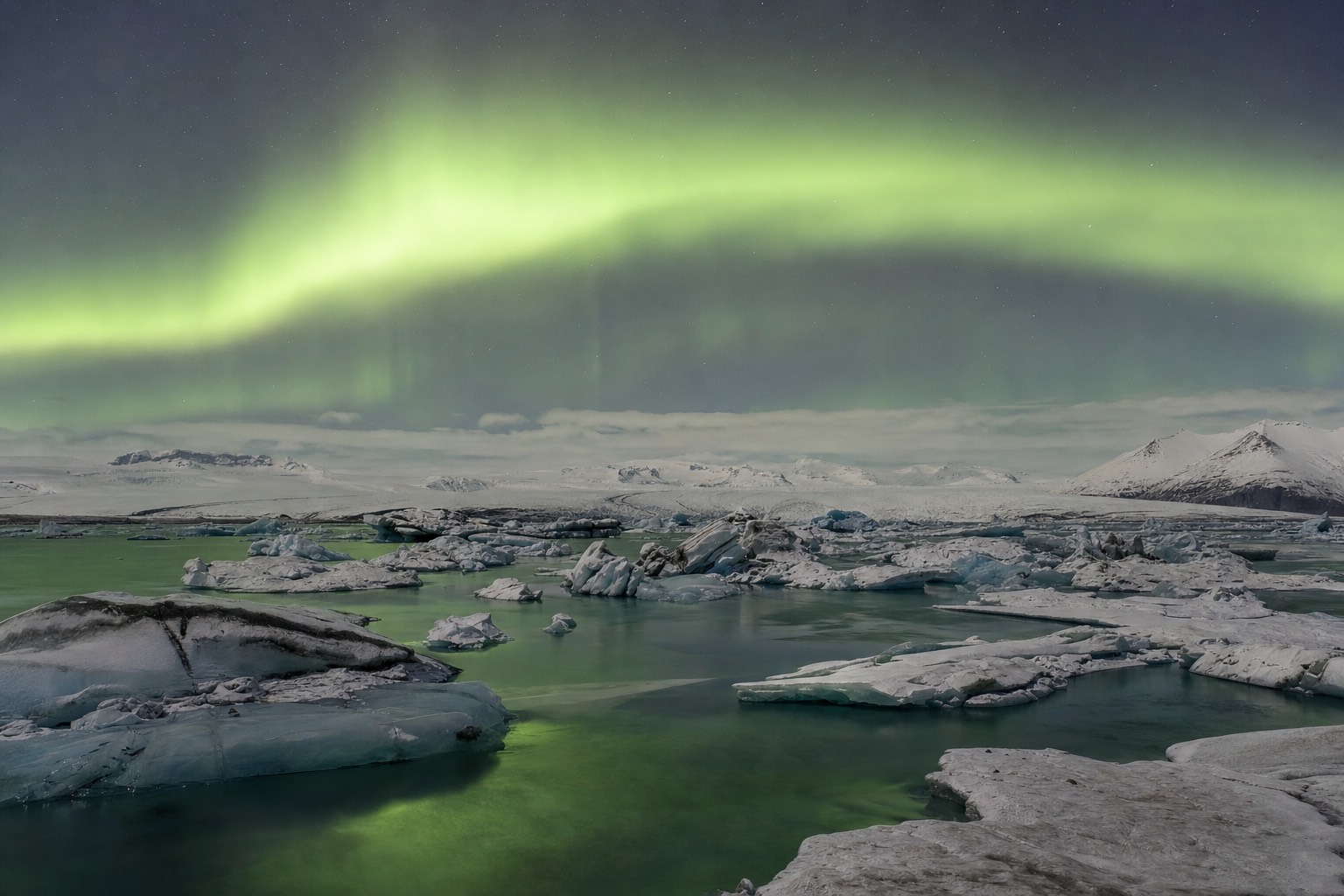
Green light folding over a lagoon full of icebergs is the photograph half of Iceland comes here chasing, and this dark corner of the south-east is one of the best places to catch it.
 Written with Björn Einarsson, Iceland South Coast & glacier-lagoon tour guide and local specialist
Short answer
Yes, aurora is possible over Jökulsárlón and Diamond Beach from roughly September to April, when nights are dark. The south-east coast has almost no light pollution, which helps. No tour guarantees it, though. You need darkness, clear skies, and solar activity to line up on the same night.
The first time I saw the aurora reflected in the lagoon, I nearly dropped my flask. A pale green band had been sitting flat over the glacier for twenty minutes, doing not much, and then it snapped into ribbons and the whole sheet of water lit up underneath it, icebergs floating in a soft green glow. That double image, the sky and its mirror, is what makes this stretch of coast special for aurora. You are not just looking up. You are looking at a foreground almost nowhere else can offer.
I guide this south-east corner, so I have stood out here on a lot of cold nights waiting for the sky to do something. Sometimes it delivers. Sometimes the cloud wins and you drive home with nothing. Let me walk you through when the lights are actually possible here, how to read the forecast the way locals do, and the honest truth about whether a day trip from Reykjavík will get you under them.
Can you see the northern lights at Jökulsárlón and Diamond Beach?
Yes, and the setting is close to ideal. Aurora is visible here on dark, clear nights from about late August to mid-April. This part of the south-east has almost no light pollution, so the sky is genuinely black. The catch is that you still need clear weather and enough solar activity, and nobody can promise all three at once.
What makes the lagoon and beach stand out is the foreground. Most aurora photos are just sky, maybe a silhouette of a hill. Here you get icebergs on black sand or floating in still water, catching the colour from below. On a good night the reflection doubles the show, which is why photographers time whole trips around a clear-sky window at Breiðamerkursandur.
The darkness is real and it matters. Reykjavík and even smaller towns throw up a glow that washes out faint aurora, but out here the nearest real town is Höfn, roughly 80 km east, and there is very little else. That black backdrop lets you see weaker displays that would vanish over a city. It also means you want a plan, because there is nowhere to duck inside and warm up between bursts.
None of that changes the hard rule. A dark, low-pollution site improves your odds, it does not create the aurora. You still need the sky clear and the sun cooperating. I have stood here under a perfect black sky and seen nothing but stars, and I have watched people two fields away in cloud miss a display I could see. It is a lottery you can load in your favour, not a certainty.
When is aurora season at the glacier lagoon?
Aurora season runs roughly from late August to mid-April, tracking the dark half of the year. The statistically strongest months tend to be around the equinoxes, September and March, when geomagnetic activity often peaks and nights are already long. Summer is a write-off: under the midnight sun it never gets dark enough for the lights to show at all.
The reason summer is out is simple. The aurora is up there year-round, but you can only see it against a dark sky, and from roughly May through July the south coast barely gets true night. By late August the darkness returns and the season opens. From then through the winter the nights are long enough that you have real hours to work with, and by the depths of December you have darkness for most of the day.
People assume mid-winter is automatically best because the nights are longest, and there is truth in that. But December and January also bring the cloudiest, stormiest weather, so all that darkness gets you nothing if the sky stays covered. That is why many locals quietly rate the shoulders, late September and March, when you still get long nights but a better shot at a clear one. Those months also sit near the equinoxes, when aurora activity statistically runs higher. Since you are out here on the long winter nights anyway, most aurora visitors fill the short daylight with the natural ice caves that run the same season; you can check the Vatnajökull ice cave tour here.
Here is the whole year laid out for aurora specifically, separate from daylight or ice on the beach. If you want the full picture of how the seasons trade off against each other, I break that down in the month-by-month guide to visiting Diamond Beach.
| Month | Night dark enough? | Aurora odds | Notes |
|---|---|---|---|
| September | Yes, from late Aug | Good to strong | Equinox activity, milder weather |
| October | Yes | Good | Longer nights, roads still mostly open |
| November | Yes, long nights | Good | Weather turning, cloud more likely |
| December | Darkest of the year | Fair | Longest nights but often stormy/cloudy |
| January | Very long nights | Fair | Same cloud problem as December |
| February | Long nights | Good | Skies often clearer than mid-winter |
| March | Yes | Good to strong | Equinox activity, lengthening days |
| Early-mid April | Fading, short nights | Fair, then closing | Season winds down as light returns |
| May to August | No, midnight sun | None | Too bright to see aurora at all |
What conditions do you actually need to see the aurora?
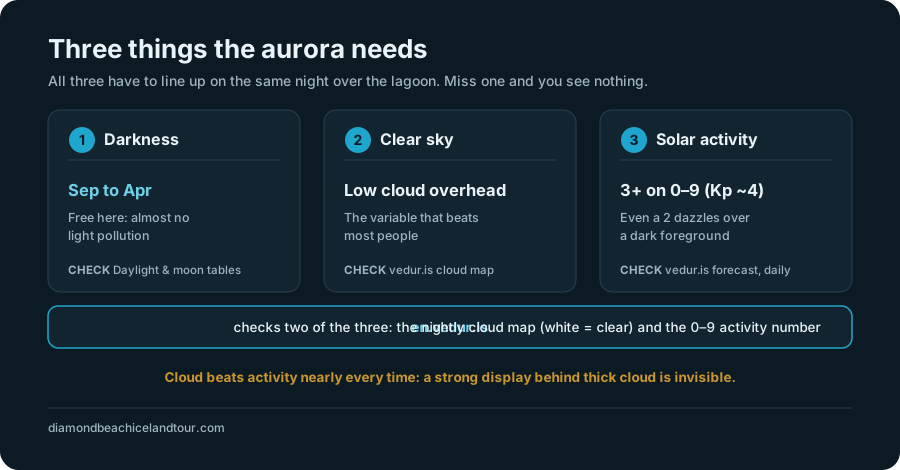
Three things have to line up on the same night: darkness, a clear or low-cloud sky, and enough solar activity. Miss any one and you see nothing. Darkness you get for free here in season. Clear sky is the variable that beats most people. Solar activity is what the aurora forecast measures, but clouds override it every time.
I think of it as a checklist where every box has to be ticked. The good news is that the location already ticks two: this coast is dark and low on light pollution by default, so you are not fighting a city glow. The two you have to actively chase are the weather and the sun. Of those, weather is the one that ruins more trips than anything else, because a strong display behind thick cloud is invisible.
The one piece of luck worth knowing about right now is the sun itself. The current solar cycle has been near its maximum through 2024 and 2025, which pushes aurora frequency and intensity up across these years. That does not guarantee your night, but it tilts the base rate in your favour more than a quieter stretch of the cycle would.
| Condition | What you need | How to check it |
|---|---|---|
| Darkness | A night in season, Sep-Apr, ideally away from the fullest moon | Daylight and moon tables for the date |
| Clear sky | Low cloud cover directly overhead at the lagoon | Met Office cloud-cover map on the aurora page |
| Solar activity | Aurora activity around 3+ on the 0-9 scale, or Kp roughly 4+ | Met Office aurora forecast, updated daily |
| Dark location | Little to no light pollution nearby | Already true at Jökulsárlón; just get away from car headlights |
How do you read the vedur.is aurora forecast?
The Icelandic Met Office runs the forecast most locals trust, at en.vedur.is. It shows two things that both matter: an aurora activity number from 0 to 9 for that night, and a cloud-cover map of the whole country where white means clear and green means cloudy. You want a decent activity number AND white sky over the south-east.
The activity scale is more forgiving than people expect. It runs 0 to 9, and you do not need a big number for a memorable night. Even a 2 counts as low but can still be beautiful over a dark foreground like this, and a 3 is enough to get properly dazzling ribbons. So do not write off a night just because the forecast is not screaming a high figure.
The part people skip is the cloud map, and that is the mistake that costs them the show. The Met Office aurora forecast at en.vedur.is overlays cloud on the map precisely because cloud, not activity level, is what usually blocks the view. Learn to read it: find the south-east coast, and if it is white there you have a window, even on a modest activity night. If it is solid green, a high activity number will not help you.
One more habit worth copying. Check the forecast late, not days out, because cloud predictions this far north shift fast. I also glance at safetravel.is before any night drive on this coast, since chasing a clear patch in winter can mean moving between weather systems, and road conditions matter more than the aurora if it turns. The best hours are usually the dead of night, roughly 22:00 to 02:00, with displays often strongest around 22:30 to 01:00.
Will the day tour from Reykjavík catch the northern lights?
Maybe, but do not count on it. The guided day trip is a lagoon-and-beach tour, not an aurora hunt. In winter it returns to Reykjavík well after dark, so if the sky happens to be active and clear on the drive home, you may catch the lights from the coach. That is a bonus, not the plan, and it is never guaranteed.
Here is the honest mechanics of it. This is a very long day, around 14 hours, with roughly five to six hours of driving each way over about 380 km. In the short days of winter, a big chunk of that return leg happens in full darkness. So on the right night, the odds of glimpsing aurora through the window are real. I have had guests on winter coaches see a display flare up somewhere around the south coast on the way back, and it makes their whole trip.
But look at what you cannot control from a moving coach. You cannot stop and wait for a cloudy patch to clear. You cannot pick your spot for a clean foreground. You are on a fixed schedule, pointing wherever the road points, often with the lagoon itself far behind you by the time it is fully dark. The aurora over the icebergs, that mirror-image shot, is not really a day-tour outcome. It is a stand-still-at-the-lagoon-at-night outcome.
So set your expectations right. Book the day trip for the lagoon, the beach, and the drive, all of which it delivers reliably, and treat any aurora on the way home as a gift. If the lights are the entire reason you are coming, the day tour is the wrong tool, and the next section is for you.
| Factor | Day tour from Reykjavík | Overnight near the lagoon |
|---|---|---|
| Aurora odds | Low to moderate, only on the dark drive back | Best odds, you are there when it gets dark |
| Where you'd see it | Through the coach window on Route 1 | At the lagoon or beach, with the ice as foreground |
| Flexibility | Fixed return time, no waiting out cloud | Wait for a clear window, try multiple nights |
| The dream photo | Not really possible from a moving bus | Aurora mirrored in the lagoon is on the table |
| Effort and cost | One long day, no extra nights | Accommodation plus more time on the coast |
What is the best way to boost your aurora odds here?
Stay at least one night close to Jökulsárlón in season, so you are on the spot when darkness falls and can wait out the cloud. Watch the vedur.is forecast for a clear-sky night, and give yourself more than one evening if you can. The day tour is the easy way to see the lagoon itself; an overnight is the way to actually chase the lights over it.
If aurora is your priority, the move is to base yourself out here rather than trying to see everything from Reykjavík in a day. Even one night changes the maths completely: you are already at the dark foreground when the sky opens, you can drive a few minutes to dodge a cloud bank, and you are not watching the clock for a coach. On where to base yourself for that, I put together options in where to stay near Jökulsárlón. Winter visitors often pair an aurora night with an ice-cave tour during its short season, since both live in the same dark months.
That said, plenty of people are here for the whole south-east experience and just want the aurora as a possible extra. If that is you, the guided day trip is the sensible, low-stress way to reach the lagoon and beach without driving the winter roads yourself. Book the guided Jökulsárlón & Diamond Beach day trip and check live availability and prices on GetYourGuide. It runs year-round with a live guide and free cancellation up to 24 hours out, and in winter that late, dark return leg is where any roadside aurora would show up.
The lagoon under the aurora is one of those sights that spoils you for ordinary night skies afterward. Give it darkness, a clear forecast, and a little patience, and this dark south-east coast will hand you a better version of the show than almost anywhere with a roof and a town nearby. Just come knowing the sky owes you nothing, and let it surprise you.