Can You Walk From the Glacier Lagoon to Diamond Beach?
The lagoon and the beach sit on opposite sides of one road, close enough that most people underestimate how quickly they connect.
 Written with Björn Einarsson, Iceland South Coast & glacier-lagoon tour guide and local specialist
Short answer
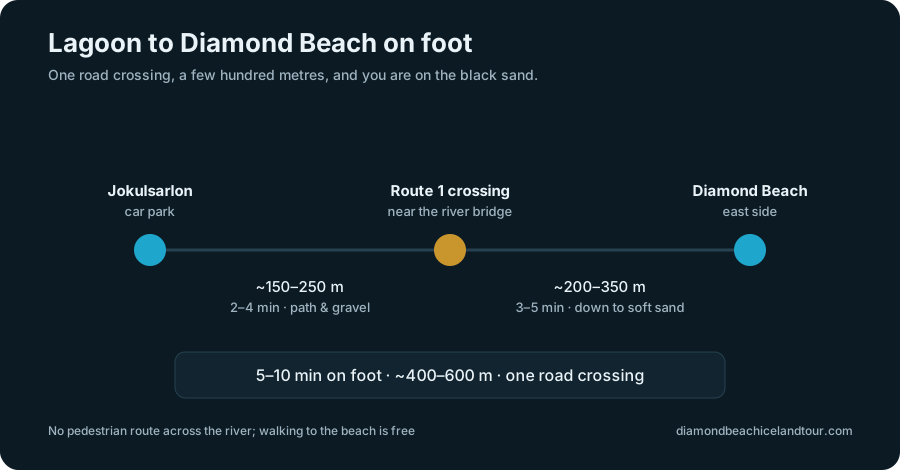
Yes. Diamond Beach sits directly across Route 1 from Jökulsárlón, a 5 to 10-minute walk from the lagoon car park down to the ocean side. You cross the ring road near the river bridge on foot, no boat or long drive needed to reach the ice on the sand.
People stand at the edge of Jökulsárlón, watch the icebergs drift toward the sea, and then ask me where the famous black beach with the diamonds actually is. The answer usually surprises them: it is right there, on the far side of the road they just drove in on. The lagoon empties into the ocean through a short river channel, and the ice that survives the current gets pushed back onto the sand a few hundred metres away. You do not need a second stop or a separate drive. You need a coat and about ten minutes on your feet.
Can you walk from Jökulsárlón to Diamond Beach?
Yes, easily. Diamond Beach lies directly across Route 1 from the Jökulsárlón car park, roughly a 5 to 10-minute walk. You follow a short path down toward the ocean, cross the ring road near the river bridge, and you are on the black sand where the icebergs wash up. No boat, no shuttle, no long detour required.
This catches a lot of first-timers off guard, because the two names get sold as separate attractions. They are really one place split by a road. The glacier lagoon sits on the inland side, calm and full of floating ice. The river drains it southward under a bridge to the sea, and Diamond Beach is the black shore on the ocean side where stranded bergs pile up. Same water, same ice, two sides of one crossing.
Because it is so short, I always tell people to do both in a single visit rather than treating the beach as an afterthought. Walk the lagoon first, watch the bergs move, then follow them on foot to where the ocean deposits them. Seeing the same ice in both settings, drifting and then beached, is the whole point of the place. If you are still deciding whether the beach earns the stop at all, I lay out the honest case in my guide on whether Diamond Beach is worth it.
How far is the walk from the glacier lagoon to the beach?
It is short. From the main Jökulsárlón car park down to the east side of Diamond Beach is roughly 400 to 600 metres, about 5 to 10 minutes at a relaxed pace on flat, mostly firm ground. The only real effort is the last stretch across soft black sand, which slows you down more than the distance suggests.
The path is not a groomed promenade, so wear proper footwear. In summer it is straightforward walking. In winter the same route can be icy or wind-battered, and the sand near the waterline turns heavy and wet, so give yourself the full ten minutes rather than rushing. There is no charge to walk to the beach itself, though the lagoon car park now carries a parking fee, currently around 1,110 ISK, set by Vatnajökull National Park, which manages the whole area.
Here is how the short distances break down, so you can plan your time on foot rather than guessing.
| Segment on foot | Rough distance | Time at an easy pace | Ground underfoot |
|---|---|---|---|
| Lagoon car park to the road crossing | ~150–250 m | 2–4 min | Path and gravel, flat |
| Road crossing to the east beach | ~200–350 m | 3–5 min | Path down to soft sand |
| Along the east beach itself | as far as you like | open-ended | Soft black sand, heavy near surf |
| East side to west side (via the bridge) | ~1 km by road | drive, ~2 min | Not a safe walking route |
The takeaway is simple: reaching the ice is quick, but budget extra minutes for the sand and for stopping every few steps to photograph it. Most people who "only wanted a quick look" end up staying far longer than they planned.
What is on each side of the road, the lagoon versus the beach?
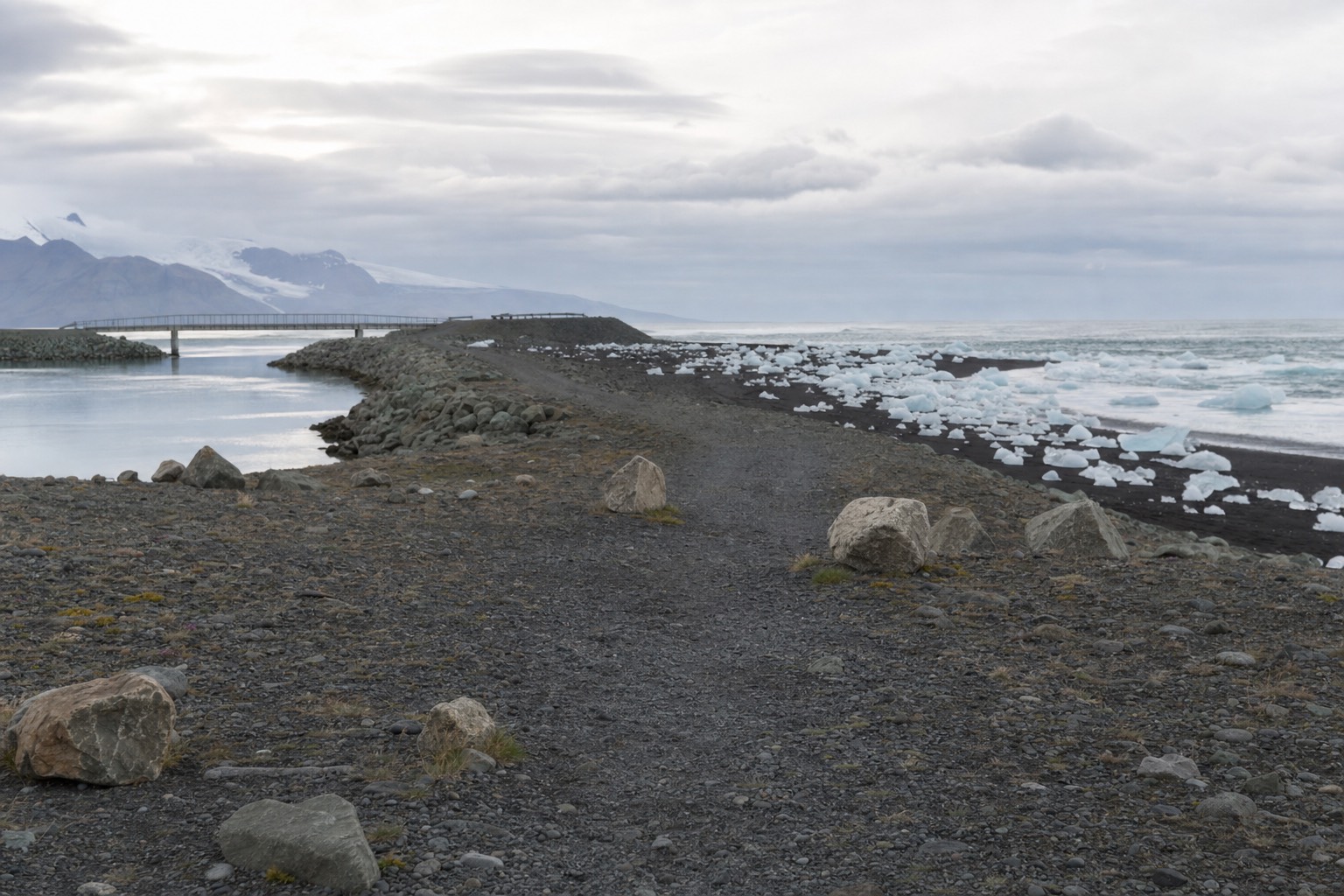
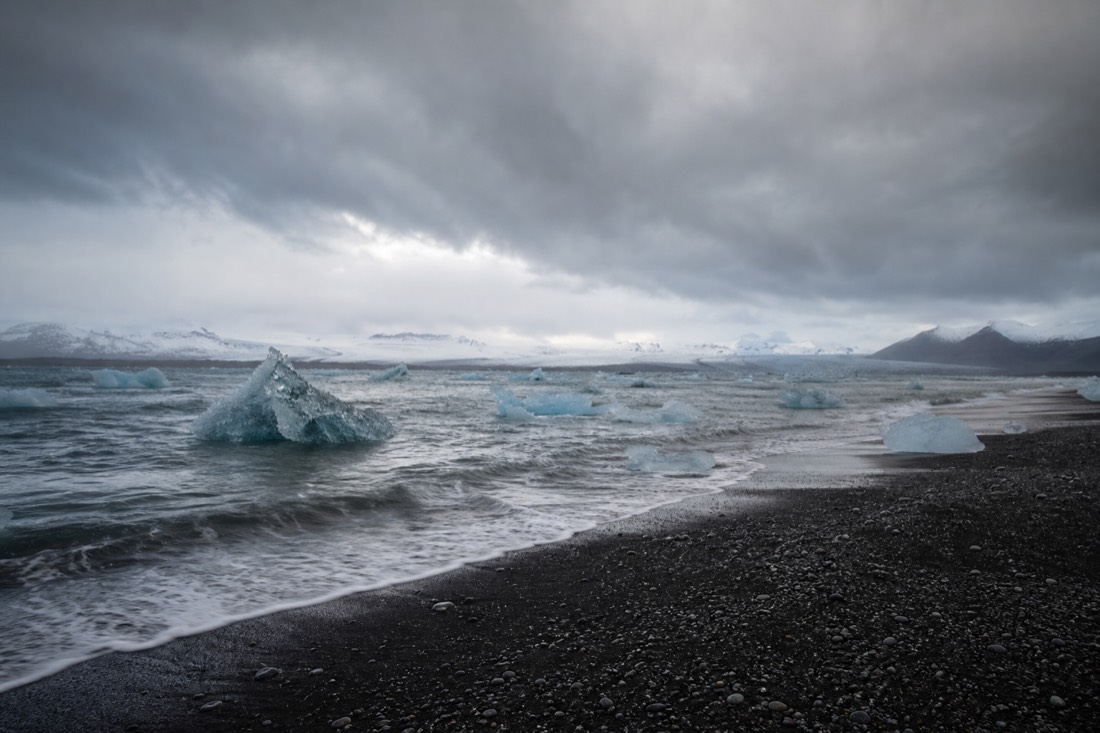
The inland side is the lagoon: still water, drifting icebergs, seals, and the glacier tongue behind it. The ocean side is Diamond Beach: black volcanic sand strewn with stranded ice polished by the surf. One is calm and glassy, the other raw and loud, and the same bergs move from the first to the second.
Understanding the split helps you spend your time well, because the two sides reward different things. At the lagoon you slow down and watch. Icebergs the size of cars drift in near silence, seals surface between them, and if you catch it right the water mirrors the whole scene. This is also where the optional boat cruise runs, seasonally, from around April to October. The beach is the opposite mood: wind, waves, and ice you can walk right up to on the sand.
Here is the honest contrast, so you know what each side actually gives you.
| Lagoon side (Jökulsárlón) | Beach side (Diamond Beach) | |
|---|---|---|
| The scene | Floating icebergs on still water | Stranded ice on black sand |
| Mood | Calm, quiet, reflective | Windy, loud, dramatic |
| Best for | Watching bergs and seals drift | Close-up ice, contrast photos |
| Wildlife | Seals, seabirds | Occasional seals offshore |
| Water activity | Optional boat cruise (Apr–Oct) | None; the sea here is dangerous |
| Time I suggest | 45–60 min | 30–45 min |
If you only have time for one, I would not make you choose, because the walk between them is so short. That is exactly why the pairing works: two very different experiences of the same ice, a few minutes apart. For a fuller breakdown of pacing, see how long you actually need at Jökulsárlón.
Is it safe to cross Route 1 and walk near the bridge?
Mostly yes, with real caution at two points: the road and the sea. Route 1 here narrows to a single-lane bridge over the river, and traffic can move fast, so cross the road, not the bridge, and watch for cars. On the sand, sneaker waves and rip currents are the genuine danger, not the walk itself.
The bridge is the part people misjudge. It is a single-lane structure carrying two directions of Ring Road traffic over the Jökulsá river outlet, and it is built for vehicles, not pedestrians. Do not walk along it to get between the two sides of the beach. Cross the road on foot where it is safe and flat, keep children close, and treat the traffic seriously, especially in low winter light when drivers are tired after a long haul east.
The sea is the hazard that actually hurts people. Iceland's official safetravel.is warns repeatedly about sneaker waves and strong rip currents along the south coast, and Diamond Beach is no exception: waves arrive in irregular sets and a large one can surge far up the sand without warning. The water is glacial and dangerously cold. Keep well back from the waterline, never turn your back on the sea, and do not climb on beached icebergs, which can roll in an instant. One more thing the national park guidance makes plain: never try to cross the river on foot or hop between ice to reach the far side. The channel is deep, fast, and full of moving ice. The only safe way between the two beach sides is to drive the short loop across the bridge.
Which side of Diamond Beach has more ice?
It varies by day and tide, but as a rule the quieter west side, reached by crossing the bridge, often catches the larger stranded bergs, while the busier east side nearest the lagoon car park is the most convenient and reliably has ice too. Neither side is guaranteed, since the display resets with every tide.
There are two beach areas, one on each side of the river mouth, each with its own parking. The east side is the one most visitors reach on foot from the lagoon: closest to the cafés and boat departures, easiest to combine with the lagoon in a single walk. The west side is a separate stop across the bridge, less crowded, and it tends to collect the bigger pieces of ice because of how the current and prevailing conditions push bergs ashore there. If you are self-driving and have time, seeing both is worth the two-minute hop.
Do not fixate on picking the "right" side before you arrive, because the ice moves on its own schedule. I have watched an almost bare stretch of sand fill with fresh bergs over a single afternoon as the tide turned. If your first look is thin, walk the lagoon, come back, and check again. For more on where exactly this all sits and how the geography works, my guide on where Diamond Beach is in Iceland maps it out.
How does the day tour handle the walk versus self-driving?
A guided day tour parks at the lagoon, gives you a set window, and walks the group down to the east side of Diamond Beach, so the crossing and timing are handled for you. Self-driving lets you linger and hop across the bridge to the west side, but you own the long Route 1 drive and the winter conditions that come with it.
On the featured coach trip, the driver handles the ~380 km each way from Reykjavík, and once you arrive you get scheduled stops at the lagoon and Diamond Beach without having to drive the Ring Road home in the dark. The trade-off is flexibility: the itinerary gives you scheduled stops rather than the freedom to move between both beach parking areas whenever you choose. For a large-group full day with the logistics taken care of, that is a fair deal, and in winter it removes the real risk of driving an icy Ring Road yourself.
Here is how the two approaches compare on the things that actually matter at this crossing.
| What matters here | Guided day tour | Self-drive |
|---|---|---|
| The long Route 1 drive | Handled by the coach driver | You drive ~380 km each way |
| The road/bridge crossing | Follow the stop instructions and cross with care | You cross on foot yourself |
| Which beach side you get | Not specified in the itinerary | Either, drive across the bridge to the west |
| Time at the stops | Scheduled within a multi-stop day | As long as your own itinerary allows |
| Winter conditions | No self-driving risk | You manage ice and short daylight |
| Parking and transport logistics | Coach transport is handled | You arrange and pay for your own driving and parking |
If the handled version suits you, this is the one I would point you to: book the guided Jökulsárlón & Diamond Beach day trip and check live availability and prices on GetYourGuide. It is a 14-hour coach trip from Reykjavík with an English-speaking guide, bus transportation and onboard WiFi. Pickup and the seasonal lagoon boat depend on the option selected, and the tour is not suitable for children under 6.
So, can you walk between them easily?
Yes. This is one of the easiest "two attractions" walks in Iceland: 5 to 10 minutes from the lagoon car park, across the road near the bridge, onto the black sand. The only things to respect are the traffic at the crossing and the sea at the beach. Do both, in one visit, on foot.
After years of standing at this spot, my honest advice is to slow down and use the short distance rather than rushing between two ticked boxes. Watch the ice leave the lagoon, then walk the few minutes to meet it again on the sand. Keep back from the waves, mind the road, and let the place do its work. For most visitors this crossing is the highlight of the whole south-east coast, and it costs you nothing but ten minutes and a bit of care.
Your Next Step
Choose how to handle the journey from Reykjavík
Initial editorial suggestion. Confirm your date and party requirements with the operator.
Have a Reykjavík travel date in mind? Check the 14-hour coach options before arranging your rental car and the rest of your South Coast transport.
Ages 6+. Allow for delays. Meals are extra; glacier hiking and ice-cave visits are separate experiences.
Refine Your Choice And View Alternatives
Reykjavik: Jokulsarlon Glacier Lagoon & Diamond Beach Tour
14-hour coach trip from Reykjavík with an English-speaking guide, Jökulsárlón and Diamond Beach stops. Pickup and the seasonal boat ride depend on the booked option.
This tool compares tour formats, meeting points, listed ages, seasonal windows and duration. Seasonal guidance is not live availability. It does not confirm availability or personal suitability. Local activities do not include the drive from Reykjavík; leave extra time for travel and check-in.